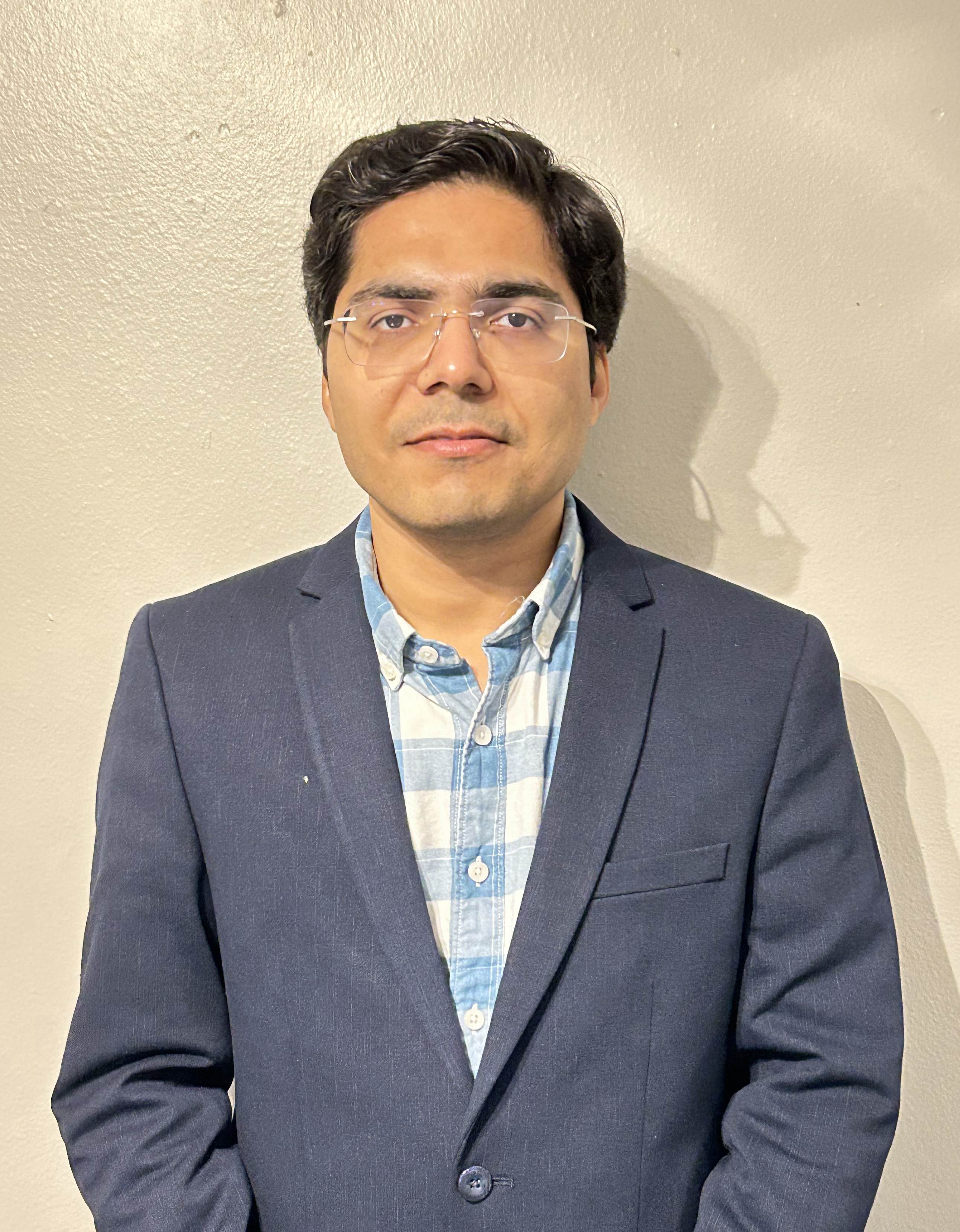
Abhinaw Kumar
PhD, Computational Chemistry (University of Utah) • Machine learning + molecular simulation
My research focuses on bridging coarse-grained and atomistic simulations using machine-learning–based backmapping. Using diphenylalanine as a model system, I develop probabilistic normalizing-flow models that generate ensembles of atomistic structures consistent with a given coarse-grained configuration. This approach captures conformational diversity, preserves correlations between internal degrees of freedom, and produces physically realistic structures that can be used directly in molecular dynamics simulations. Ongoing work focuses on reweighting these ensembles to recover Boltzmann statistics and study peptide self-assembly at atomistic resolution.
Generative modeling
Multiscale simulation
Statistical mechanics
IDPs & assemblies
Soft matter
Porous materials
Research Interests
- Probabilistic CG→AA backmapping: Develop machine-learning–driven probabilistic models grounded in statistical thermodynamics to bridge coarse-grained and atomistic descriptions
- Protein physics, with a focus on intrinsically disordered proteins, aggregation, and sequence–structure–dynamics relationships
- Soft matter and biomolecular self-assembly: spanning mesophases, liquid crystals, and collective behavior in complex fluids
- Nucleation & polymorph selection in porous materials and nanoscale systems
Research Trajectory
Now (Postdoctoral Researcher) - University of Arkansas (Monroe Group)
Machine-learning-driven probabilistic CG→AA backmapping with reweighting.
Postdoctoral Researcher - Texas A&M University (Mittal Group)
Protein–DNA interactions and condensate/chromatin compaction dynamics.
Postdoctoral Researcher - UT Austin (Thirumalai Group)
Optimized force fields for intrinsically disordered proteins (e.g., FUS); aggregation physics.
PhD, Computation Chemistry - University of Utah (Molinero Group)
Nanoparticle self-assembly; nucleation and polymorph selection of porous materials.
BS/MS Dual Degree in Chemistry - IISER Pune
Polymers–lipid bilayer interactions (Dr. Sudip Roy).
International research experience
University of Saarbrücken (Germany)
Comparative studies on nanocluster structure (Prof. Michael Springborg).
University of Surrey (UK)
TD-DFT calculations for circular dichroism spectra of neuropeptides (Prof. Brendan Howlin).
Working style
I enjoy building methods that are both physically grounded and computationally practical: clear assumptions, reproducible pipelines, and results that connect simulation to measurable observables.