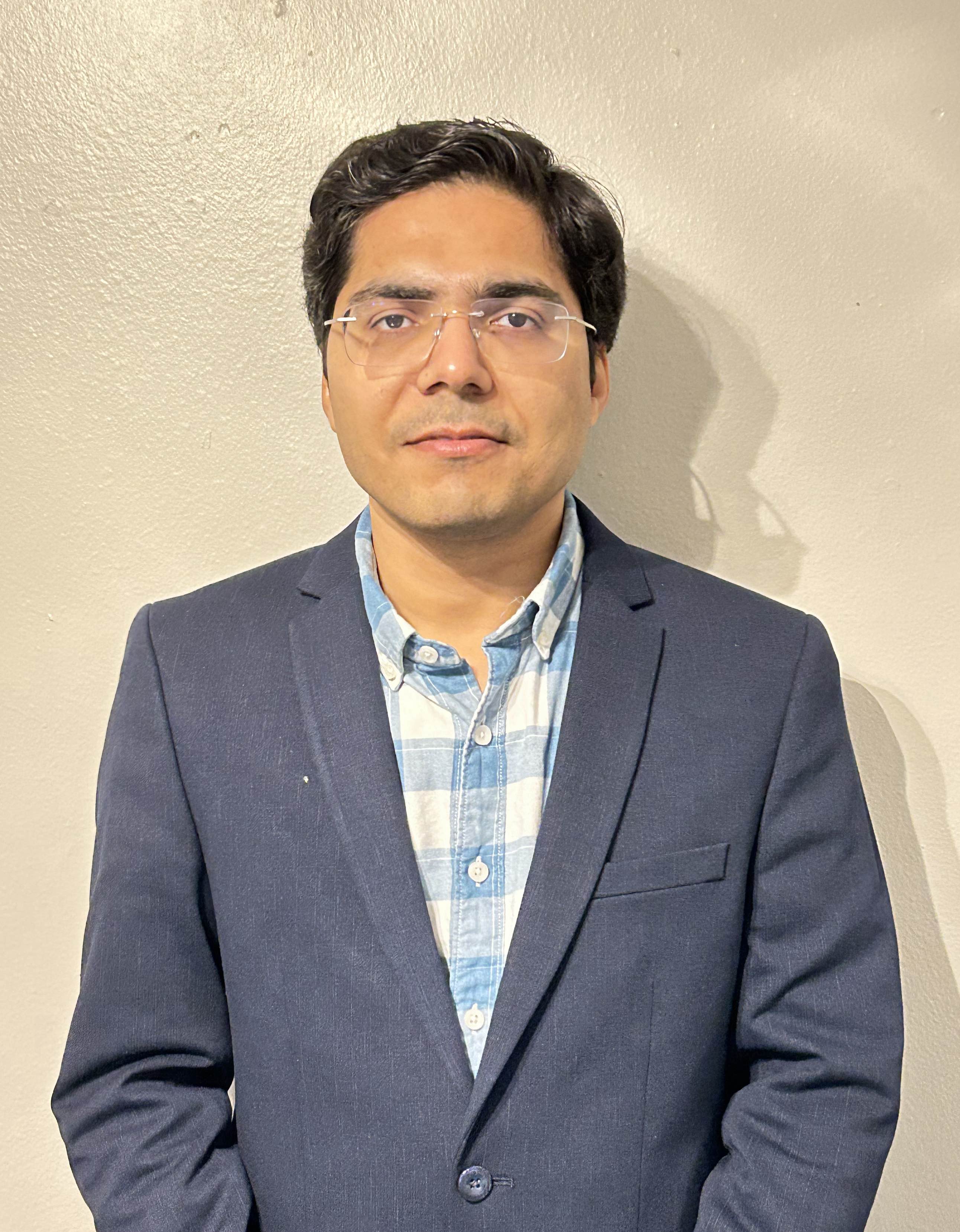
Abhinaw Kumar
PhD, Computational Chemistry (University of Utah) · Postdoctoral Research Associate, University of Arkansas
I am a computational chemist working at the intersection of machine learning and molecular simulation. I build reduced molecular models that retain the essential physics of complex systems, use them to study self-assembly, nucleation, and biomolecular aggregation, and develop probabilistic methods that connect coarse-grained and atomistic descriptions.
Current Research
Since 2024 I have been a Postdoctoral Research Associate in the Ralph E. Martin Department of Chemical Engineering, University of Arkansas, working with Prof. Jacob Monroe. I develop machine-learning-based probabilistic backmapping: autoregressive normalizing flows that generate all-atom structures from coarse-grained representations of the diphenylalanine (FF) peptide, validated with structural, energetic, and statistical metrics, molecular-dynamics refinement, and ensemble reweighting.
Manuscript in preparation: BoltzMap — probabilistic backmapping of coarse-grained peptides with normalizing flows (A. Kumar, S. Paschall, J. Monroe, 2026).
Research Trajectory
At Texas A&M University (Mittal group, 2023–2024) I simulated HP1–DNA condensates with coarse-grained HPS models to uncover mechanisms of chromatin compaction. At UT Austin (Thirumalai group, 2019–2023) I showed that sequence determines the switch in the fibril-forming regions of the FUS protein, and helped optimize coarse-grained force fields for intrinsically disordered proteins validated against experimental SAXS profiles.
Foundations
My PhD with Prof. Valeria Molinero at the University of Utah established that nanoparticles with simple isotropic interactions can self-assemble into ordered mesophases, introducing the model now known as the Kumar–Molinero (KM) model, and showed that metastable mesophases can mediate zeolite nucleation and polymorph selection.
Dissertation: Self-Assembly of Mesophases and Their Role in the Nucleation and Polymorph Selection of Zeolites.
Research Impact
The KM model has been independently used, reproduced, benchmarked, or extended by groups at Cornell, Clemson, Penn State, Seoul National University, and CONICET/UNMdP for nucleation, enhanced sampling, machine-learning structure recognition, particle dynamics, and nanoparticle design. The coarse-grained zeolite model was adopted by researchers at Utrecht University as the basis of an inverse-design workflow for zeolite frameworks (ACS Nano 2025).
Recognition
ACS Petroleum Research Fund 25th-Anniversary Collection (2025) — first-author J. Phys. Chem. Lett. 2018 article selected among 40 highly cited PRF-funded articles in the JPC journals since 2000. ACS Most Read Physical Chemistry Articles of the Month (October 2017) — first-author J. Phys. Chem. Lett. 2017 article. Poster selected in the top 10% of submissions at the ACS Fall 2026 meeting.
Training & Global Perspective
BS–MS dual degree in Chemistry with distinction from IISER Pune (INSPIRE Fellow), with research internships at the National Chemical Laboratory, Pune; Saarland University, Germany (DAAD Fellowship); and the University of Surrey, UK (UKIERI Fellowship). These experiences shaped an interdisciplinary, global approach to computational science.